
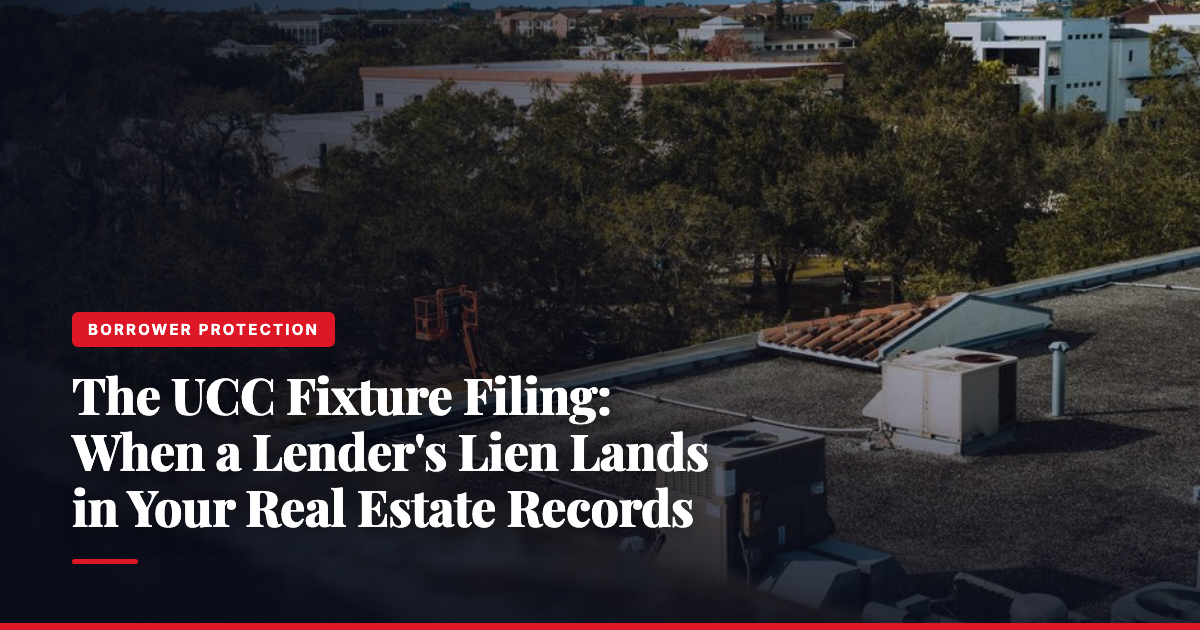
A fixture filing is a special UCC-1 that a lender records in the real-property records for the county where your building sits, not just the central UCC index. It lets the lender claim collateral that has been attached to real estate — an HVAC system, a walk-in cooler, built-in machinery — as a “fixture.” Done correctly and on time, it can outrank even your mortgage holder on that specific equipment. Done late, it loses.
Most business owners picture a lien as something abstract: a filing in a state database that shows up when a lender pulls your records. A fixture filing is different. It deliberately crosses into the real-estate world — the same county land records where deeds and mortgages live — and plants a flag on equipment that has become part of your building.
That crossover is the whole point, and it is where owners get surprised. You financed a piece of equipment thinking it was “just equipment.” Once it is bolted, wired, or plumbed into the structure, the law may treat it as a fixture: part personal property, part real estate. A fixture filing is how a lender keeps its claim alive on both sides of that line.
What a fixture actually is
Under Article 9 of the Uniform Commercial Code, which nearly every U.S. state has adopted, a fixture is goods that have become “so related to particular real property that an interest in them arises under real property law.” The UCC itself does not draw the final line — it defers to each state’s real-property rules on when a thing stops being movable goods and becomes part of the land.
Courts generally weigh three things:
- Annexation — how firmly the item is attached. Bolted, welded, hard-wired, or plumbed in points toward a fixture.
- Adaptation — whether the item is specially fitted to the building’s use, like a walk-in cooler built into a restaurant wall.
- Intent — whether the parties meant the item to stay permanently. Intent is usually judged by the first two factors plus any written agreement.
Common fixtures in a small business: HVAC and refrigeration systems, elevators, built-in ovens and hoods, large stationary machinery on a concrete pad, solar arrays, and sometimes signage. Loose, unattached equipment usually is not a fixture.
Why the filing lives in two places
An ordinary UCC-1 financing statement is filed centrally — almost always with the Secretary of State — and it covers movable business personal property. A fixture filing is filed instead (or additionally) in the real-property records of the county where the building is located, indexed against the land the way a mortgage is.
The UCC spells out what a fixture filing has to contain. Beyond the usual debtor and secured-party names and a description of the collateral, Section 9-502(b) requires that the record indicate it covers fixtures, state that it is to be filed in the real-property records, describe the real property, and — if the debtor does not own the land — name the record owner.
The reason for the double life is simple: a title searcher looking at your building’s land records would never think to also check a statewide UCC index. Recording the lien where real estate is recorded puts future buyers and mortgage lenders on notice.
The priority fight: who wins the equipment
Here is the part that matters most to a borrower. When a thing is both equipment and part of a building, two camps can claim it: the lender who financed the equipment, and whoever holds a mortgage on the real estate. UCC Section 9-334 sets the tie-breakers.
The headline rule favors a lender with a purchase-money security interest — money that was actually used to buy the fixture. If that lender perfects by making a fixture filing before the goods become fixtures, or within 20 days after the goods become fixtures, its interest in that equipment generally beats an earlier real-estate mortgage. That is a narrow, time-sensitive window, and missing it flips the outcome.
What this means in plain terms:
- A punctual fixture filing can let your equipment lender pull the HVAC unit out from under the bank that holds your building mortgage — on that unit only.
- A late or missing fixture filing usually hands that equipment to the mortgage holder as part of the real estate.
- Two lenders can end up with competing, overlapping claims on the same piece of machinery, and your business is caught in the middle.
What it means when you are the borrower
You will usually meet a fixture filing in one of three moments.
1. At closing on an equipment loan
If you are financing something that will be attached to your building, expect the lender to ask for a fixture filing — and often a landlord’s or mortgagee’s waiver or consent if you lease the space or already have a mortgage. That consent is the mortgage holder agreeing not to claim the equipment. Read it. A lender that cannot get the waiver may still file, setting up the priority fight above.
2. When you try to sell or refinance the building
Because the filing sits in the land records, a title search for a sale or refinance will surface it. A buyer’s title company may treat it as a cloud on title and demand it be cleared before closing. If the underlying loan is paid, you want a termination; if it is not, you are negotiating.
3. When the equipment loan is paid off
A fixture filing does not vanish on its own. Like any UCC financing statement, it is effective for five years from filing and then lapses unless continued — but a lapse is not the same as a clean release, and a stale filing in your land records can still spook a title examiner. After payoff, get the lender to file a termination (a UCC-3) in the same real-property records. Confirm it was recorded; do not take “we’ll take care of it” on faith.
The traps to name out loud
A few things reliably bite owners:
- The wrong office. A fixture filing recorded only at the Secretary of State — not in the county land records — may fail to give the real-estate priority the lender wanted, and a filing in the wrong county is worse than none. This is the lender’s problem to get right, but it becomes your problem in a priority dispute.
- Silent cross-collateralization. A fixture filing can be paired with a dragnet clause that sweeps in future advances. Know what the lien actually secures, not just the one machine you think you financed.
- Leased premises. If you do not own the building, the filing has to name the record owner of the land, and your lease may restrict what you can attach. A fixture dispute can pull your landlord in.
- Removal costs. Even a lender that wins priority may owe the real-estate owner for physical damage caused by ripping the fixture out. That does not help you keep the equipment, but it shapes how aggressively a lender actually moves.
Takeaway
A fixture filing is not a scare tactic; it is a lender doing exactly what the UCC lets it do to protect a loan on equipment that becomes part of your building. The borrower’s job is to know three things: what the lien covers, whether your mortgage holder signed off, and whether it gets cleared from your land records the day the loan is paid. Treat the county real-property records as part of your loan file, not someone else’s paperwork, and a fixture filing stays a routine formality instead of a surprise at your next sale or refinance.
Questions business owners actually ask
Is a fixture filing the same as a regular UCC-1?
No. A regular UCC-1 is filed centrally, usually with the Secretary of State, and covers movable personal property. A fixture filing is recorded in the county real-property records against the land itself and covers goods that have become part of the building.
Can an equipment lender really outrank my building’s mortgage?
On the specific fixture, yes. Under UCC Section 9-334, a purchase-money lender that makes a fixture filing before the goods become fixtures — or within 20 days after — generally beats an earlier real-estate mortgage on that equipment. Miss the window and the mortgage holder typically wins.
How long does a fixture filing last?
Like other UCC financing statements, it is effective for five years from the filing date and then lapses unless a continuation is filed. A lapse is not a formal release, so you still want a termination recorded after payoff.
What should I do when the loan is paid off?
Get the lender to file a UCC-3 termination in the same county real-property records where the fixture filing was recorded, then confirm it was actually recorded. A paid-but-uncleared filing can hold up a future sale or refinance.
What counts as a fixture?
Goods attached to real property firmly enough that real-property law gives someone an interest in them — think HVAC systems, built-in refrigeration, elevators, or large machinery on a pad. Loose, easily moved equipment usually is not a fixture. States apply annexation, adaptation, and intent tests.
Sources
Every figure in this article is traceable to a primary source. Rules and rates change — verify against these before acting.
- Legal Information Institute — UCC § 9-334 (Priority of Security Interests in Fixtures)
- Legal Information Institute — UCC § 9-502 (Contents of Financing Statement; Fixture Filing)
- Legal Information Institute — UCC § 9-102 (Definitions, including “fixtures” and “fixture filing”)
- Legal Information Institute — UCC § 9-515 (Duration and Effectiveness of Financing Statement)
Important: MidBank is not a bank, a financial institution, or a financial advisor. We are an advocate and ISO affiliate that connects businesses to vetted third-party providers. This article is general information published on November 15, 2026, not legal, tax, or financial advice — rules and rates change, and your situation is specific to you. Confirm details with the primary sources linked above and with a qualified tax or legal professional before acting.
Not sure which option fits your business?
That is the conversation we have every day. No cost, no obligation — we tell you what we would do if it were our money.
Schedule a ConsultationGet Started