
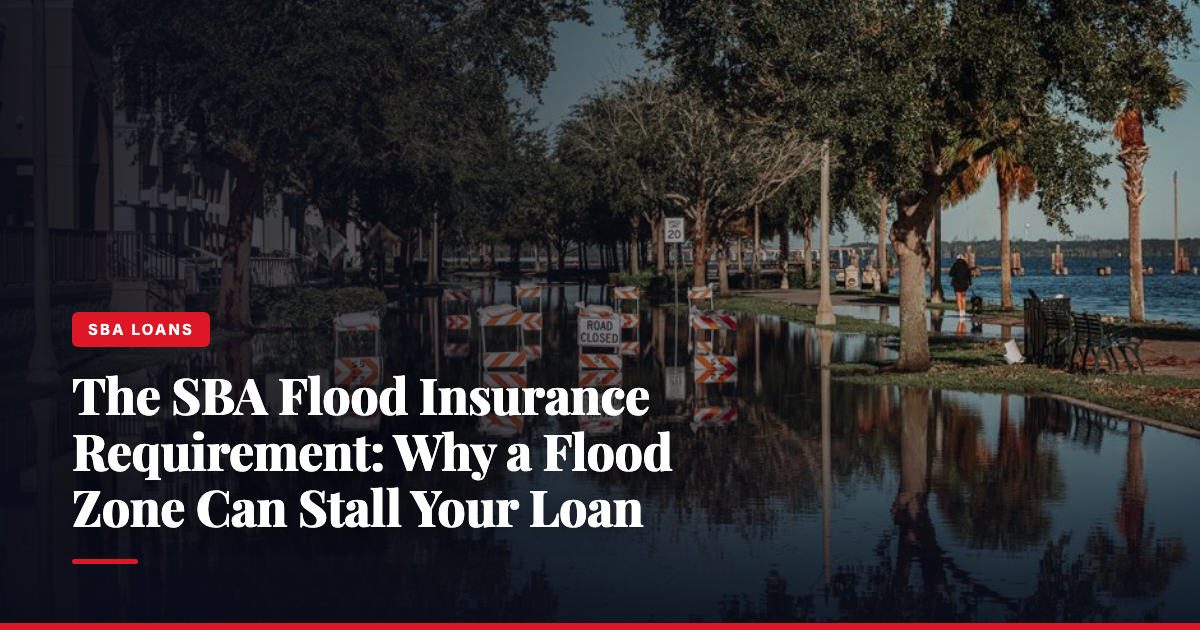
If any real estate or business property pledged as collateral on your SBA loan sits in a FEMA-designated Special Flood Hazard Area, federal law — the Flood Disaster Protection Act — requires you to carry flood insurance before the loan can close and for the life of the loan. It is not your lender being cautious; it is a legal condition of getting a federally backed loan, and it can change your closing timeline and your monthly cost.
Most borrowers find out about the flood rule late — usually when a closing checklist lands and there is a line item for a flood insurance policy nobody mentioned. It is one of the few loan conditions your lender genuinely cannot waive, because it is not the lender's rule at all. It is federal law. Here is what triggers it, what it costs you, and where borrowers get surprised.
Where the requirement actually comes from
The mandatory purchase of flood insurance is written into the Flood Disaster Protection Act of 1973. The law says a federally regulated lender — and a federally backed loan like an SBA 7(a) or 504 loan qualifies — may not make, increase, extend, or renew a loan secured by a building in a Special Flood Hazard Area (SFHA) unless the building is covered by flood insurance for the term of the loan.
An SFHA is any area FEMA has mapped as having a 1% or greater chance of flooding in a given year. FEMA labels these zones with letters that begin with A or V on its Flood Insurance Rate Maps. If your collateral building sits inside one of those zones, the requirement switches on automatically. Your lender does not get to decide whether the risk is real; the map decides.
What sets it off on an SBA loan
The trigger is the collateral, not the loan purpose. If your loan is secured by real estate — the building you are buying, your existing commercial property, or in some cases your home taken as additional collateral — the lender has to run a flood zone determination on every structure that secures the debt.
- Buying owner-occupied real estate with a 504 or 7(a) loan: the building being purchased gets checked.
- Pledging property you already own as collateral: that structure gets checked too, even if the loan is for working capital or equipment.
- Personal real estate taken as additional collateral: if your lender puts a lien on a home or rental property to shore up the deal, those buildings can pull the flood requirement in with them.
SBA's own program rules echo the federal law: when a structure taken as collateral is in an SFHA, flood insurance is required as a condition of the loan. There is no minimum-loan carve-out and no “we think this one is fine” exception.
The flood determination — and why it can be wrong in your favor
Early in underwriting, your lender orders a Standard Flood Hazard Determination Form from a flood zone vendor. That form states whether each building is in or out of an SFHA. Two things borrowers should know about it.
First, the determination is tied to a specific structure, not the whole parcel. A large lot can have a building sitting on high ground outside the zone even when part of the land floods. Second, the determination can be challenged. If you believe your building was mapped into a flood zone by mistake — for example, the structure sits above the base flood elevation on fill — you can pursue a Letter of Map Amendment (LOMA) from FEMA. A successful LOMA removes the structure from the SFHA and can eliminate the mandatory purchase requirement entirely.
Before you buy a policy you may not need, pull the address on FEMA's Flood Map Service Center yourself and read the zone. If your building looks like it was swept in by a broad-brush map line, ask about a LOMA early — not the week of closing.
How much coverage you actually have to carry
The rule does not require you to insure the building for its full market value. The required amount is the lowest of three numbers: the outstanding loan balance, the insurable value of the building, or the maximum coverage available under the National Flood Insurance Program (NFIP) for that property type.
For a commercial (non-residential) building, the NFIP maximum building coverage is $500,000, with a separate $500,000 limit for contents. That ceiling matters on larger commercial deals: if your building is worth more than the NFIP cap and your lender wants it fully protected, you may need excess flood coverage from a private insurer on top of the NFIP policy. That is a real, recurring cost worth pricing before you commit to a property.
Where borrowers get surprised
- It stalls closing. A flood policy has to be in force at loan closing. If the determination comes back “in zone” a week before funding, you are now shopping for a policy on a deadline. Order the determination early so you know your status weeks ahead.
- It is not a one-time cost. Coverage has to stay in place for the life of the loan. Let the policy lapse and your lender can force-place a policy for you — usually at a higher premium than one you would buy yourself — and add the cost to what you owe.
- Contents may need separate coverage. NFIP building coverage does not automatically cover your inventory, equipment, or fixtures. If those secure the loan, expect a contents policy too.
- Rising water only. Flood insurance covers damage from external rising water. A burst pipe or a sewer backup is a different peril under a different policy. Do not assume your general property insurance and your flood policy overlap — read both.
- New maps change the math. FEMA remaps areas over time. A building that was out of the zone when you bought it can be mapped in later, and once your lender learns of it, the requirement applies going forward.
What to do with this before you sign
Treat the flood question as due diligence on the property, not paperwork at the end. A few concrete moves protect you:
- Check the address yourself on FEMA's Flood Map Service Center before you make an offer, so a flood zone is priced into the deal from day one.
- Ask for the flood determination early in underwriting rather than waiting for the closing packet.
- Get a real premium quote from an NFIP-participating agent — and, if the building is high-value, a quote for excess coverage — before you sign a purchase contract.
- If the mapping looks wrong, ask your lender and a surveyor about a LOMA before you buy a policy you might not owe.
- Budget it as a permanent line item, not a closing fee. It is part of the true carrying cost of the property for as long as you hold the loan.
The takeaway
The SBA flood insurance requirement is not your lender being overly careful and it is not negotiable at the branch level — it is a federal condition attached to the collateral the moment a mapped building secures your loan. The borrowers who handle it well are the ones who learn their flood status early, price the premium before they commit to a building, and check whether they were mapped into a zone by mistake. The ones who get hurt are the ones who meet the requirement for the first time on the closing checklist, with a funding date they can no longer move.
Questions business owners actually ask
Can my lender waive the flood insurance requirement if my building is in a flood zone?
No. The mandatory purchase requirement comes from the Flood Disaster Protection Act, a federal law, not from your lender's internal policy. If a building securing a federally backed loan sits in a Special Flood Hazard Area, coverage is required and the lender cannot waive it.
How do I find out if my property is in a Special Flood Hazard Area?
You can look up any address on FEMA's Flood Map Service Center for free. Your lender will also order an official Standard Flood Hazard Determination during underwriting, which states whether each collateral structure is in or out of an SFHA.
How much flood coverage does the SBA require me to carry?
The required amount is the lowest of three figures: your outstanding loan balance, the insurable value of the building, or the maximum coverage available under the National Flood Insurance Program for that property type — which is $500,000 for a commercial building, with a separate $500,000 limit for contents.
What happens if I let the flood policy lapse?
Your lender can force-place a policy on your behalf, typically at a higher premium than you would pay on your own, and add that cost to your loan balance. Coverage has to stay in force for the entire life of the loan.
What if I think my building was mapped into a flood zone by mistake?
You can request a Letter of Map Amendment (LOMA) from FEMA. If FEMA agrees the structure is not actually in the Special Flood Hazard Area — for example, it sits above the base flood elevation — the mandatory purchase requirement can be removed.
Does flood insurance cover my inventory and equipment too?
Not automatically. NFIP building coverage insures the structure; a separate contents policy covers inventory, equipment, and fixtures. If those items secure your loan, your lender will likely require contents coverage as well.
Sources
Every figure in this article is traceable to a primary source. Rules and rates change — verify against these before acting.
- FEMA — National Flood Insurance Program: Mandatory Purchase of Flood Insurance
- FEMA — Flood Map Service Center
- FEMA — Letters of Map Amendment (LOMA) / Map Change
- FEMA — National Flood Insurance Program Coverage Limits
- U.S. Small Business Administration — Lender and Development Company Loan Programs (SOP 50 10)
Important: MidBank is not a bank, a financial institution, or a financial advisor. We are an advocate and ISO affiliate that connects businesses to vetted third-party providers. This article is general information published on September 30, 2026, not legal, tax, or financial advice — rules and rates change, and your situation is specific to you. Confirm details with the primary sources linked above and with a qualified tax or legal professional before acting.
Not sure which option fits your business?
That is the conversation we have every day. No cost, no obligation — we tell you what we would do if it were our money.
Schedule a ConsultationGet Started